Chiller Van in Dubai
Chiller Van in Dubai: Complete 2025 Guide
If you’re searching for a chiller van in Dubai, you already know one thing: the UAE heat is not forgiving. Temperatures regularly exceed 45°C in summer, and that window between a product leaving a warehouse and arriving at its destination can mean the difference between a fresh delivery and a spoiled one.
This guide was written for business owners, logistics managers, procurement teams, and anyone who needs to move temperature-sensitive cargo across Dubai and the UAE — without guesswork. You’ll find honest pricing, the right questions to ask a provider, how Dubai’s regulations work, and practical advice from operators running refrigerated fleets across all seven emirates.
What Is a Chiller Van and Who Actually Needs One?
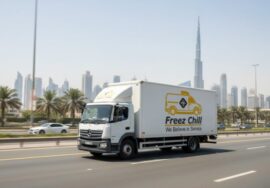
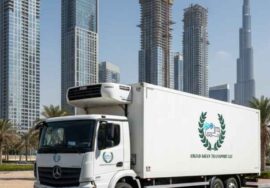
A chiller van is a refrigerated vehicle that maintains a controlled temperature — typically between +2°C and +8°C — throughout the entire journey, regardless of outside conditions. It’s not a regular delivery van with a cool box. A proper chiller van uses a dedicated refrigeration unit (Carrier or ThermoKing are the industry benchmarks) mounted to the cargo area, with insulated walls and a sealed loading door.
You need a chiller van in Dubai if you’re transporting any of the following:
- Fresh produce, vegetables, and fruits
- Dairy products — milk, cheese, yoghurt
- Raw meat, poultry, or seafood
- Pharmaceuticals and vaccines
- Fresh flowers and floral arrangements
- Ready-to-eat meals and chilled beverages
- Specialty foods — artisan pastries, confectionery, premium ingredients
If your cargo needs to stay below room temperature at all times, a standard cargo van simply isn’t compliant with Dubai Municipality or ADAFSA (Abu Dhabi Agriculture and Food Safety Authority) regulations. It also puts your goods — and your reputation — at risk.
Table of Contents
Chiller Van vs. Freezer Van: Which One Do You Need?
This is the single most common question we receive, and it matters more than most people realize. Choosing the wrong vehicle type can mean cargo rejection, regulatory non-compliance, or spoiled goods.
Chiller Van in Dubai — Temperature Range: +2°C to +8°C | Best For: Fresh produce, dairy, pharma, flowers | Starting Daily Rate: AED 250/day
Freezer Van — Temperature Range: -18°C to -25°C | Best For: Frozen food, ice cream, frozen meat | Starting Daily Rate: AED 300/day
The simple rule: if the product can tolerate being in a standard refrigerator, it needs a chiller van in Dubai. If it needs to be frozen solid, it needs a freezer van.
Some businesses run mixed loads — for example, a supermarket replenishing chilled yoghurt and frozen desserts at the same time. For these operations, separate vehicles or partitioned trucks are the right solution. Our team at Amjad Khan Transport can advise on the most cost-efficient configuration for your route.
Dubai’s Cold Chain Regulations: What Every Business Must Know
Operating a food or pharmaceutical delivery business in Dubai means working within a regulatory framework that’s stricter than many businesses expect — and rightly so. Non-compliance doesn’t just mean fines; it can mean licence suspension, cargo seizure, or damage to supplier relationships.
HACCP Certification
HACCP (Hazard Analysis and Critical Control Points) is the internationally recognized food safety management system. Dubai Municipality and ADAFSA require HACCP-compliant transport for food businesses. This means the vehicle itself, its hygiene standards, and its temperature control systems must all meet specific requirements.
When hiring a chiller van in Dubai, always ask your provider for their HACCP certification documentation. A legitimate operator will provide it without hesitation.
GDP Compliance for Pharmaceuticals
If you’re transporting medicines, vaccines, clinical samples, or biologics, your logistics provider must adhere to GDP (Good Distribution Practice) — the WHO-aligned framework for pharmaceutical cold chain management. This includes temperature logging, route documentation, and driver training protocols.
GDP-compliant chiller van in Dubai operators provide temperature data logs for every journey — essential for pharmaceutical audits and regulatory submissions.
Dubai Municipality Guidelines
Dubai Municipality conducts random inspections of refrigerated vehicles, particularly those operating in Deira’s wholesale markets, JAFZA, and along key food distribution corridors. Vehicles found with non-functioning refrigeration units, improper hygiene, or missing documentation face immediate penalties.
What this means for you: work only with providers whose vehicles carry current certifications, and always request documentation before a booking is confirmed.
Chiller Van in Dubai Pricing in Dubai: 2025 Market Rates
Pricing transparency is rare in the UAE logistics sector. Here’s an honest breakdown of what you should expect to pay in 2025.
1-Ton Chiller Van (Hiace/Urvan) | Up to 1,000 kg | AED 250/day | AED 1,663/week | AED 6,750/month
3-Ton Chiller Van (Dyna/Canter) | Up to 3,000 kg | AED 350/day | AED 2,328/week | AED 9,450/month
1-Ton Freezer Van | Up to 1,000 kg | AED 300/day | AED 1,995/week | AED 8,100/month
3-Ton Freezer Van | Up to 3,000 kg | AED 400/day | AED 2,660/week | AED 10,800/month
5-Ton Chiller Truck | Up to 5,000 kg | AED 500/day | AED 3,325/week | AED 13,500/month
10-Ton Freezer Truck | Up to 10,000 kg | AED 750/day | AED 4,988/week | AED 20,250/month
Base rates include the refrigerated vehicle. Driver cost, fuel, and cross-emirate tolls may apply depending on your booking type. Always request a written, itemized quote before confirming.
What Affects Your Final Price?
Route distance and emirate: Dubai local deliveries are priced differently from Abu Dhabi or Sharjah runs. Cross-emirate routes include Salik tolls, driver time, and fuel.
Duration: Weekly bookings save 5% vs. daily rates. Monthly contracts save 10%. For businesses with regular routes, a monthly agreement almost always makes financial sense.
Driver or self-drive: Hiring with a professional, UAE-licensed driver adds a predictable cost but removes compliance risk — your driver is trained in cold chain protocols and can handle documentation at checkpoints.
Cargo type: Standard food deliveries vs. pharmaceutical GDP-compliant routes require different documentation and handling, which can affect pricing.
Red Flags in Chiller Van in Dubai Pricing
Be cautious of providers who quote an unusually low rate verbally but add charges after booking, cannot provide a written quote before confirmation, or don’t mention fuel, toll, or driver costs upfront. Reputable operators like Amjad Khan Transport provide complete, itemized quotes in writing before any booking is confirmed.
How to Choose a Chiller Van in Dubai Company
With dozens of providers competing for your business, here are the questions that separate reliable cold chain operators from those who will leave your cargo at risk.
1. Are the vehicles HACCP certified?
This is non-negotiable for food businesses. Ask for the certification document — not just a verbal assurance. HACCP certification covers the cargo area, refrigeration unit, hygiene standards, and temperature monitoring systems.
2. What refrigeration units do they use?
Industry-standard units are Carrier and ThermoKing. These are designed for the UAE climate — they maintain temperature reliably even when ambient temperatures exceed 45°C in summer. Cheap or generic refrigeration units are a serious risk.
3. Is there GPS and real-time temperature monitoring?
GPS tracking lets you monitor your vehicle’s location. Real-time temperature monitoring lets you confirm your cargo stayed within the correct range throughout the journey. Both should be standard — not optional extras.
4. Do they provide temperature logs on request?
Temperature data logs are required for pharmaceutical deliveries and are increasingly requested by supermarket and hospitality clients as part of supplier compliance. A professional operator generates these automatically and provides them on request.
5. What is their emergency and breakdown protocol?
A refrigeration unit failure during a delivery is not just an inconvenience — it’s a potential compliance failure and cargo loss. Ask your provider what happens if a vehicle breaks down mid-route. Do they have backup vehicles? What is their response time? The answer tells you everything about how seriously they take cold chain integrity.
Industries We Serve in Dubai
Food and Beverage Distribution
Dubai’s food and beverage sector is one of the most demanding cold chain environments in the world. Wholesale distributors, restaurant groups, hotel suppliers, and supermarket chains all depend on chiller van in Dubai to keep product integrity intact from warehouse to point of delivery.
Key requirements: HACCP certification, food-grade sanitized interiors, reliable refrigeration in Dubai summer heat, flexible routing.
Recommended vehicle: 1-ton chiller van for restaurant and café deliveries; 3-ton chiller van for wholesale and supermarket replenishment.
Pharmaceutical and Healthcare
Cold chain compliance in pharmaceuticals is among the most stringent in any industry. Vaccines must stay between +2°C and +8°C continuously. Clinical samples cannot be allowed to warm. Any temperature excursion can render a shipment non-compliant.
Key requirements: GDP compliance, continuous temperature logging, trained drivers, signed proof of delivery, HACCP and GMP documentation.
Recommended vehicle: 1-ton chiller van with full GDP documentation package.
Hospitality and Catering
Dubai’s hotels, restaurants, and catering companies operate under strict food safety standards and run on tight delivery windows. An early morning kitchen delivery that arrives warm or late cascades into service failures.
Key requirements: Early morning dispatch capability, HACCP certification, reliable multi-drop routing, driver professionalism at luxury venues.
Recommended vehicle: 1-ton to 3-ton chiller van depending on order volume.
Floriculture and Events
The UAE’s events and weddings industry demands flowers that arrive in perfect condition — no wilting, no damage. Flowers are highly temperature-sensitive: most cut varieties require +2°C to +5°C transit conditions.
Key requirements: Time-critical dispatch from Dubai Flower Centre, careful loading, correct chiller temperature, delivery to hotels and wedding venues.
Recommended vehicle: 1-ton chiller van with clean, food-safe interior.
Retail and E-Commerce
Online grocery and supermarket replenishment businesses face the double challenge of consumer expectations (same-day delivery, perfect condition) and regulatory compliance. Temperature-controlled last-mile delivery is no longer optional — it’s a competitive baseline.
Key requirements: Same-day availability, multi-drop route capability, GPS tracking for customer ETAs.
Recommended vehicle: 1-ton chiller van for last-mile e-commerce; 3-ton for supermarket replenishment.
UAE Coverage: Where Can You Go?
A chiller van in Dubai based in Dubai can serve all seven UAE emirates. Here’s what you need to know about intercity routes.
Dubai (local): All areas — Deira, Al Quoz, Jebel Ali, JAFZA, Business Bay, DIP, Dubai South, Al Barsha, DIFC, and beyond. Fastest dispatch, most competitive pricing.
Abu Dhabi and Al Ain: Abu Dhabi City, Mussafah Industrial, Khalifa City, ICAD, MBZ City, and Al Ain. Regular routes available; transit time approximately 1.5 to 2 hours from Dubai.
Sharjah: Industrial Areas 1–18, Al Saja’a, Al Hamriyah, Al Majaz, and Muweilah. Close proximity to Dubai makes same-day round-trips practical.
Ajman, Ras Al Khaimah, Fujairah, Umm Al Quwain: Full coverage available. Pricing includes driver time and Salik where applicable. Multi-drop intercity routes can be arranged with advance notice.
Cross-emirate tip: If you’re running regular intercity deliveries — for example, daily Sharjah-to-Dubai supermarket replenishment — a monthly contract with a dedicated vehicle almost always outperforms ad hoc daily hire on both cost and reliability.
Booking a Chiller Van in Dubai: Step-by-Step
Here’s the process that gets your delivery moving as quickly as possible.
Step 1 — Contact us: Call or WhatsApp with your required van size, pickup location, cargo type, delivery area, and date. Doing this before 10am maximizes the chance of same-day dispatch.
Step 2 — Receive a written quote: We confirm all costs in writing — base rate, driver, fuel policy, emirate tolls if applicable, and any certification documentation requirements. Never proceed without this.
Step 3 — Confirm the booking: Review the quote, confirm the cargo details (temperature range required, any GDP or HACCP documentation needed), and agree on pickup time.
Step 4 — Dispatch and monitoring: The vehicle dispatches with GPS tracking active. Real-time temperature monitoring runs continuously. You can request a temperature log after delivery.
Step 5 — Proof of delivery: For pharmaceutical and high-value deliveries, signed proof of delivery is standard. Request this in advance if your compliance process requires it.
Frequently Asked Questions
What is the minimum rental period for a chiller van in Dubai?
There is no minimum — single-day hire is available. However, weekly and monthly contracts offer 5% and 10% savings respectively, and are the better choice for businesses with regular delivery routes.
Can I hire a chiller van in Dubai without a driver?
Yes. Self-drive is available for clients with a valid UAE heavy vehicle driving licence. However, most businesses choose the with-driver option — it includes a professionally trained cold chain driver and removes compliance risk at checkpoints.
How quickly can I get a chiller van in Dubai?
Same-day dispatch is available subject to fleet availability. Contact before 10am for the best chance of same-day service. WhatsApp is the fastest channel for urgent requests.
What is the difference between a chiller truck in Dubai and a chiller van in Dubai?
Capacity and configuration. A chiller van (1-ton or 3-ton) is suited to regular distribution routes, restaurant deliveries, and last-mile logistics. A chiller truck (5-ton to 10-ton) handles high-volume cargo — supermarket bulk replenishment, industrial food distribution, catering supply chains.
Do you provide HACCP documentation for supplier audits?
Yes. HACCP certification documents are available on request and can be provided ahead of any supplier compliance audit or municipality inspection.
Are your vehicles insured?
All vehicles in our fleet are fully insured for commercial cargo transport. Documentation is available on request.